
Recognizing the strategic role of the seas and islands, Khanh Hoa has effectively promoted important resolutions to promote the development of the marine economy. Thanks to that, the potential of the seas and islands has been increasingly exploited in a modern, sustainable and internationally integrated direction.
Khanh Hoa province has a 385km long coastline and about 200 large and small islands, creating outstanding advantages for developing the marine economy. Famous bays such as Nha Trang, Cam Ranh and Van Phong are not only rich in natural resources but also have diverse ecosystems, creating a premise for strong development of marine tourism, seaports, fisheries and renewable energy.
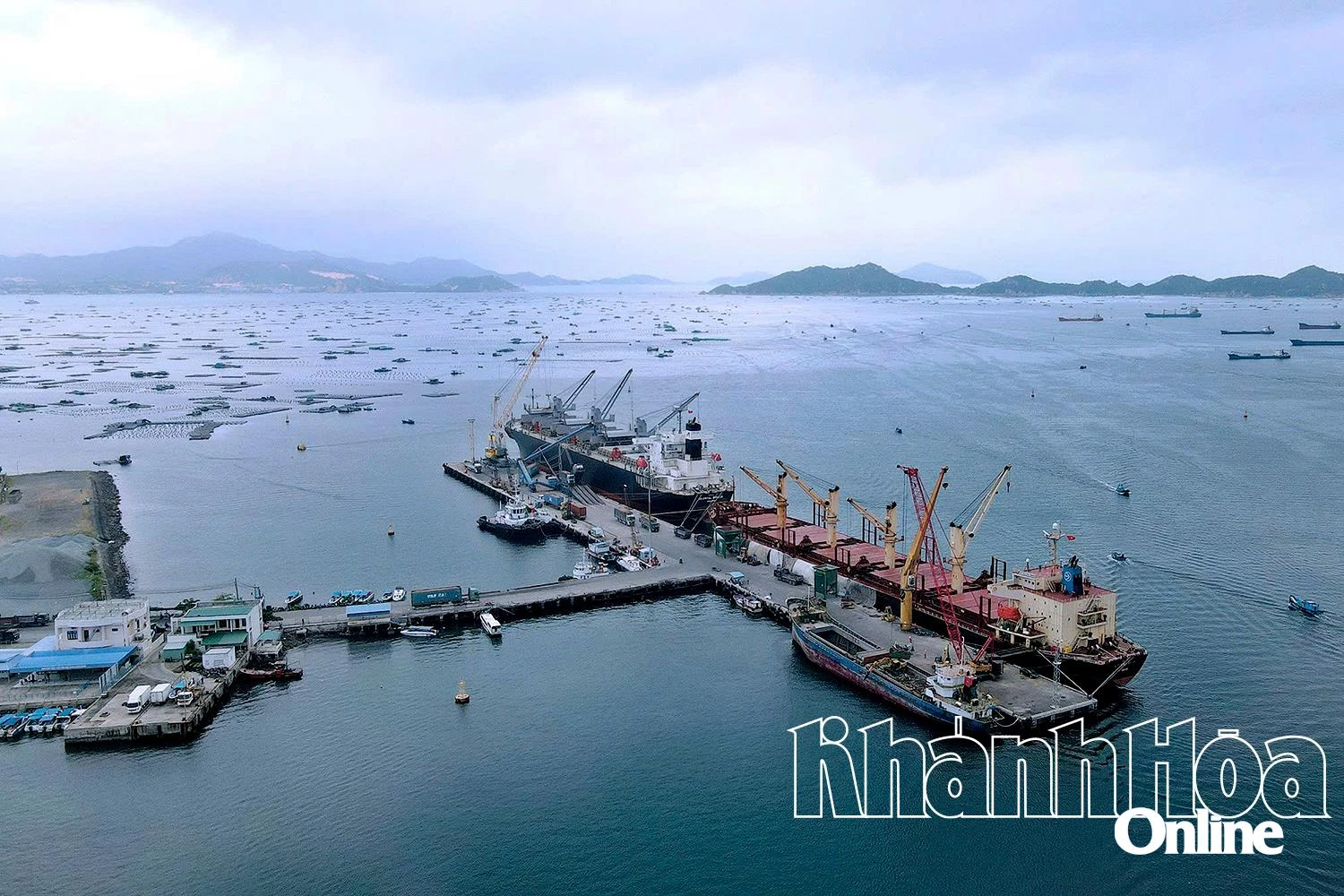 |
| Cam Ranh Port |
Tran Hoa Nam - Vice Chairman of the Provincial People's Committee said that in recent years, the province has continued to implement tasks and action programs, concretizing the directions of the Provincial Party Committee on implementing Resolution No. 36 of the 12th Party Central Committee on the Strategy for sustainable development of Vietnam's marine economy to 2030, with a vision to 2045. Along with that, the special policies from the Central Government, especially Resolution No. 09 of the Politburo on building and developing Khanh Hoa province to 2030, with a vision to 2045; Resolution No. 55 of the National Assembly on piloting a number of specific mechanisms and policies for the development of Khanh Hoa province have helped the province remove obstacles, exploit potentials, and create strong development momentum.
The province has completed the work of establishing and submitting to competent authorities for approval important plans related to the exploitation and use of marine and island resources; developing and submitting to competent authorities for consideration and approval of projects related to the use of the sea such as: Pilot project on developing high-tech marine aquaculture in Khanh Hoa; Project on building Truong Sa district into an economic, cultural, and social center at sea for the whole country; Project on establishing a national research center for ocean technology... The province has fishing ports and anchorage areas on islands in Truong Sa district to develop offshore fishing; has put into operation 17 seaports and 1 oil transshipment area, mainly general ports, petroleum ports, and specialized ports.
In 2024, the province exceeded 22/22 socio-economic targets, GRDP increased by more than 10%, exports reached more than 2 billion USD, budget revenue exceeded estimates, and social investment grew strongly. The marine and coastal economy contributes 80% of GRDP with the pillars: marine tourism, fisheries, shipbuilding industry, seaport services and logistics. In particular, tourism has recovered impressively, welcoming 10.8 million visitors, including 4.7 million international visitors. Van Phong Economic Zone attracts large investment projects, consolidating Khanh Hoa's position on the map of Vietnam's marine economy.
Currently, the central policy system is creating a solid foundation for the development of marine technology in Vietnam. Resolution No. 09 has set the goal of turning Khanh Hoa into a centrally-governed city. Khanh Hoa province has prioritized the development of high-tech marine aquaculture projects (cages made of new materials HDPE, FRP, etc.), smart coastal urban areas, and promoted the establishment of the national research center for ocean technology. Many large corporations such as Sumitomo (Japan) have invested in developing energy infrastructure and marine industry, demonstrating the strong attraction of Khanh Hoa in the field of developing a high-tech marine economy.
According to scientists, in the current period, Khanh Hoa needs to soon build an open marine data system, integrating technologies such as: AI (artificial intelligence), IoT (Internet of Things), Blockchain, big data processing and cloud computing to effectively support decision making. At the same time, the province needs to focus on training high-quality human resources, closely cooperating with universities and research institutes at home and abroad; promoting innovation, supporting marine technology startups and testing new models in aquaculture; strengthening international cooperation to access knowledge, advanced technology and building a monitoring mechanism for AI, new technology and marine robots to ensure sustainable and safe development.
According to scientists, in the current period, Khanh Hoa needs to soon build an open marine data system, integrating technologies such as AI (artificial intelligence), IoT (Internet of Things), Blockchain, big data processing and cloud computing to effectively support decision making. At the same time, the province needs to focus on training high-quality human resources, closely cooperating with universities and research institutes at home and abroad; promoting innovation, supporting marine technology startups and testing new models in aquaculture; strengthening international cooperation to access knowledge, advanced technology and building a monitoring mechanism for AI, new technology and marine robots to ensure sustainable and safe development.
According to Tran Hoa Nam, in the coming time, the province will continue to coordinate with central ministries and branches to develop mechanisms and policies to encourage businesses and people to participate in the management, conservation, exploitation and protection of marine resources and environment, and biodiversity conservation; support funding, facilities and equipment for the province to carry out the contents and tasks of comprehensive management of resources, protection of marine and island environment, and sustainable development of the marine economy...
The theme “Green technology for sustainable ocean” of Vietnam Sea and Islands Week 2025 emphasizes the pioneering role of science, innovation and green technology in protecting the ocean, developing a prosperous marine economy, and preserving national sovereignty in the new era. Currently, the province is promoting the application of green technology to the marine economy, from high-tech aquaculture, using renewable energy, controlling pollution (especially plastic waste), restoring coral reefs to developing ecotourism and integrated coastal management. The province is also taking advantage of the potential to exploit green carbon credits from coastal ecosystems, contributing to reducing greenhouse gas emissions, increasing carbon absorption capacity, aiming for a net zero emission target by 2050; prioritizing the development of high-quality marine human resources, enhancing international integration, cooperation in research and technology transfer, gradually building smart, sustainable, unique, globally connected coastal cities. With high political determination and consensus of the entire Party, government and people, the province is gradually overcoming difficulties, making the most of policy levers to promote the potential of the sea and islands towards the goal of becoming a major marine economic center of the country, a model of sustainable development and protection of sea and island sovereignty in the new era.
Vo Trong Thach - Thai Thinh
Translated by T.T






Thông tin bạn đọc
Đóng Lưu thông tin