
After more than 13 years of implementation, Van Ninh district has mobilized more than 3,699 billion VND to implement the national target program on new rural development. Up to now, the district has had 11/11 communes meeting new rural development standards, the rural appearance has gradually changed and the environmental landscape has been improved.
Van Hung commune today has many innovations, inter-commune and inter-village roads have been invested in expanding and asphalting, concreted, spacious, clean and beautiful. In the rice fields, the system of intra-field canals has been invested in solidifying to bring water to the people's fields. Tran Thanh Tong - Chairman of Van Hung Commune People's Committee said that, implementing the construction of new rural areas, the commune has introduced many new rice varieties ANS1, TBR97, BC15... with a yield of 8 tons/ha into cultivation on an area of over 500ha of people; converted more than 100ha of ineffective rice land to grow vegetables and fruit trees with high yield and value. Xuan Ha market in the commune has been invested in spaciously, serving well the buying and selling needs of the people and ensuring the environment. The whole commune currently has no temporary or dilapidated houses; the number of poor households has decreased to only 2.57%; the average income of people has reached over 63.5 million VND/person/year... The road from National Highway 1 to Van Thanh commune has been invested in spaciously, promoting economic development.
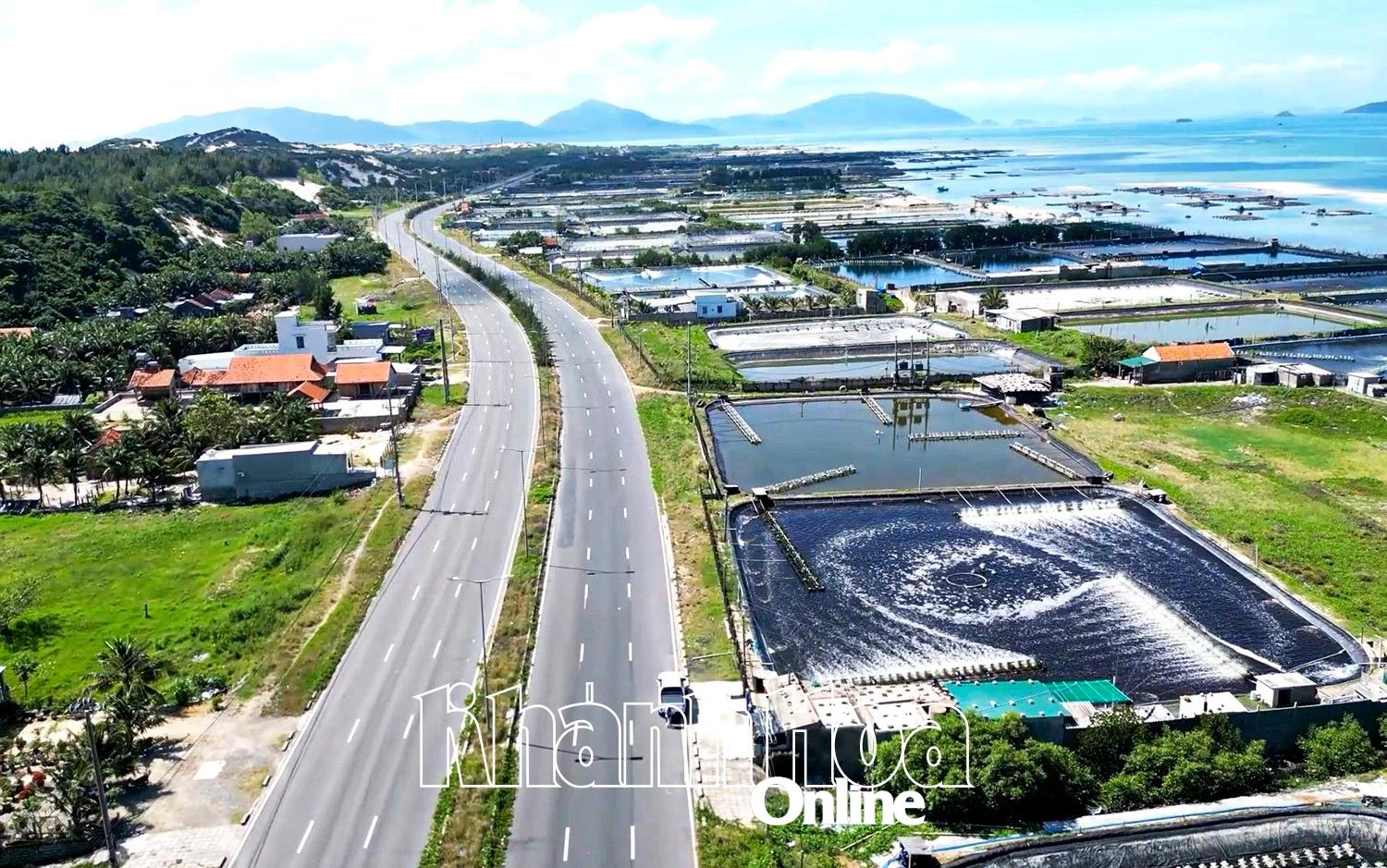 |
| The road from National Highway 1 to Van Thanh commune has been invested in, promoting economic development. |
According to Nguyen Thanh Son - Vice Chairman of Van Ninh District People's Committee, over the past 13 years, the district has mobilized more than 3,699 billion VND to implement the national target program on new rural development. Thereby, the rural appearance of the district has gradually changed, the landscape and environment have been improved towards bright, green, clean and beautiful. In particular, the socio-economic infrastructure has been strongly developed, especially rural transport, ensuring that cars can reach the centers of all communes. The district has put into mass production many new rice varieties with a yield of more than 8 tons/ha; the livestock and poultry farming of more than 1,500 households has been invested in, new knowledge has been applied, and diseases have been well controlled, bringing high efficiency to farmers; fishing and aquaculture activities have developed strongly with an output of 14,200 tons/year. Along with that, the district has established 11 cooperatives to link production and consumption of agricultural products for the people. The district also focuses on supporting the development of 13 4-star OCOP products and 43 3-star OCOP products.
Thanks to the synchronous implementation of solutions, up to now, the district has 11/11 communes achieving new rural area status, of which 4 communes have achieved advanced new rural area status and 1 model new rural area commune. The production value of the district's industry - construction sector has so far reached more than 2,000 billion VND, the trade - service sector has reached more than 1,100 billion VND, the agriculture - forestry - fishery sector has reached more than 2,000 billion VND. The multidimensional poverty rate is 3.09%; the average income per capita of the whole district is 60.98 million VND/person/year (in 2011 it was 11.97 million VND/person/year). The education system has developed in terms of scale, quantity and quality. People's health care is regularly concerned; the rate of households using hygienic water reaches 100%; political security and social order and safety are maintained... With that effort, Van Ninh district fully meets the national criteria for new rural areas in the period of 2021 - 2025. From there, the provincial steering committee for national target programs has agreed to prepare a dossier to advise the Provincial People's Committee to submit to the Central Government for consideration and recognition of meeting the standards of a new rural area in 2024 for Van Ninh district.
According to Nguyen Thanh Son, the whole district is focusing on implementing the arrangement of administrative units from 13 communes and towns to 5 communes of Van Hung, Van Ninh, Van Thang, Tu Bong and Dai Lanh. After the new commune government came into operation from July 1, the national target program on building new rural areas will continue to be implemented by the locality under the direction of the Central Government and the province and in line with the goal of developing high-class coastal tourism urban areas in accordance with Resolution No. 09 of the Politburo on building and developing Khanh Hoa province to 2030, with a vision to 2045. To successfully implement that goal, the locality will focus on vocational training and career transition for people to meet the requirements of industrialization and modernization of agriculture and rural areas. In particular, priority will be given to vocational training associated with the goal of building new rural areas in the locality with an average of 200 workers/year, linking with vocational training institutions and enterprises to create jobs for workers after vocational training and supporting career transition and employment for workers in rural areas in line with the local socio-economic development orientation. The district will also focus on developing technical infrastructure and attracting investment to develop Van Phong Economic Zone, Doc Da Trang Industrial Park; selecting to develop industries and industrial products using high technology, saving energy, consuming few resources, being environmentally friendly, and having the ability to create high economic value.
In addition, the district focuses on developing marine and island ecotourism, community tourism and cultural heritage tourism; restructuring the agricultural sector towards linking value chains; supporting the development of agricultural production in rural areas; applying science and technology, especially high technology to agricultural, forestry and fishery production; focusing on aquatic products with high economic value; applying advanced science and technology and digital transformation in the fisheries sector. The district will also develop mechanisms, policies and solutions to improve product quality, production organization capacity, gradually approaching sustainable markets according to the OCOP product value chain associated with building new rural areas; applying digital technology in product management and trade to gradually promote the OCOP brand in the domestic market and towards the export market...
Van Giang
Translated by T.T






Thông tin bạn đọc
Đóng Lưu thông tin