
Following the approval and announcement of the adjusted Khanh Hoa Province Master Plan for the 2021-2030 period (with a vision to 2050), the provincial People's Committee issued an implementation program to translate broad strategic directions into specific goals, tasks, projects, and responsibilities. This marks a crucial step in operationalizing the plan, establishing a foundation for resource mobilization and allocation, and ensuring synchronized implementation in the coming years.
Defining drivers and spaces for development
A key feature of the provincial Master Plan implementation program is the translation of long-term development directions into a system of targets for the 2026-2030 period, thereby clearly defining requirements for each economic sector. Furthermore, the program mandates not only rapid economic expansion but also a shift in the growth model toward higher value-added activities and greater scientific-technological content.
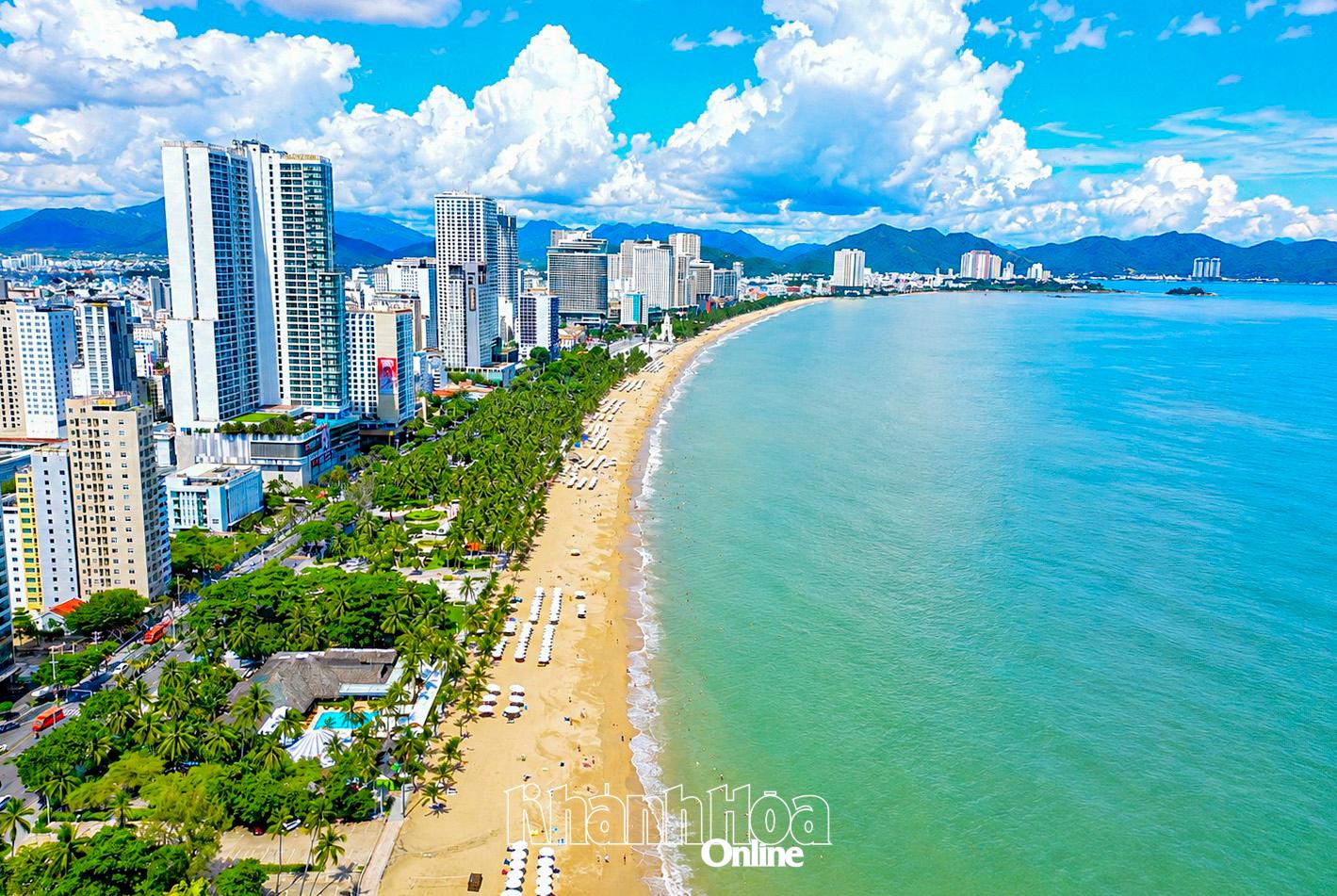 |
| A view of Nha Trang. |
The program identifies six growth sectors: tourism and quality living; innovation and artificial intelligence; maritime technology manufacturing; new energy systems; high-value processing; and strategic infrastructure and connectivity. These sectors are considered capable of effectively leveraging the province's marine advantages, geo-economic location, and new development spaces. Tourism continues to be positioned as a high-quality sector targeting long-stay visitors. The industrial sector is expanding beyond traditional processing and manufacturing into mechanical engineering, shipbuilding, new materials, digital technology, electronics, semiconductors, and supporting industries. Energy sector development is oriented toward a diverse mix, including coastal and offshore wind power, solar power, LNG, green hydrogen, nuclear power, and pumped-storage hydropower.
Another pillar is science and technology, innovation, and digital transformation. The province aims to rank among the top 10 provinces and cities nationwide in innovation and digital transformation indices by 2030, while also establishing a National Research Center for Ocean Technology, a provincial Innovation and Digital Transformation Center, and an innovation park.
Targets for the 2026-2030 period include an average annual GRDP growth rate of 11-12%, an average annual increase in state budget revenue of 12%, an urbanization rate of 70% by 2030, a trained workforce rate of 90%, and an average life expectancy of 75.5 years.
Development will continue to be organized around the three growth poles established in the provincial master plan. The northern pole, centered on Van Phong, will focus on robust industrial and maritime logistics development. The central pole, comprising Nha Trang, Cam Lam, and Cam Ranh, will serve as the hub for administration, services, knowledge, and resource coordination. The southern pole, spanning Phan Rang and Ca Na, will prioritize tourism, culture, clean energy, green industry, and innovation. This multi-polar structure, rather than a single-area focus, aims to leverage the distinct advantages of each region while fostering connectivity and distributing development momentum more broadly across the province.
To link these growth poles, the program identifies the development of integrated infrastructure as a key priority. The transport network will be aligned with the North-South economic corridor and East-West corridors connecting Van Phong to Buon Ma Thuot; Nha Trang to Dien Khanh, Khanh Vinh, and Lam Dong; and Phan Rang-Thap Cham to the Central Highlands. Infrastructure development will also encompass seaports, aviation, energy, urban facilities, and digital systems; notably, digital infrastructure is designated as essential infrastructure. The province aims to become a regional hub for Green Computing and AI, establish the Nha Trang - Cam Lam green computing corridor, build multi-purpose data centers meeting green standards, and prepare for 6G network trials in accordance with the roadmap.
These directions indicate that, compared to the overarching Provincial Master Plan, the implementation program has more clearly defined priority sectors, specific targets, and the development structure to be established by 2030.
Specific projects, resources and responsibilities
To gradually realize the Provincial Master Plan's objectives, a series of key projects, designed to foster connectivity and drive development, have been prioritized for implementation in the near future.
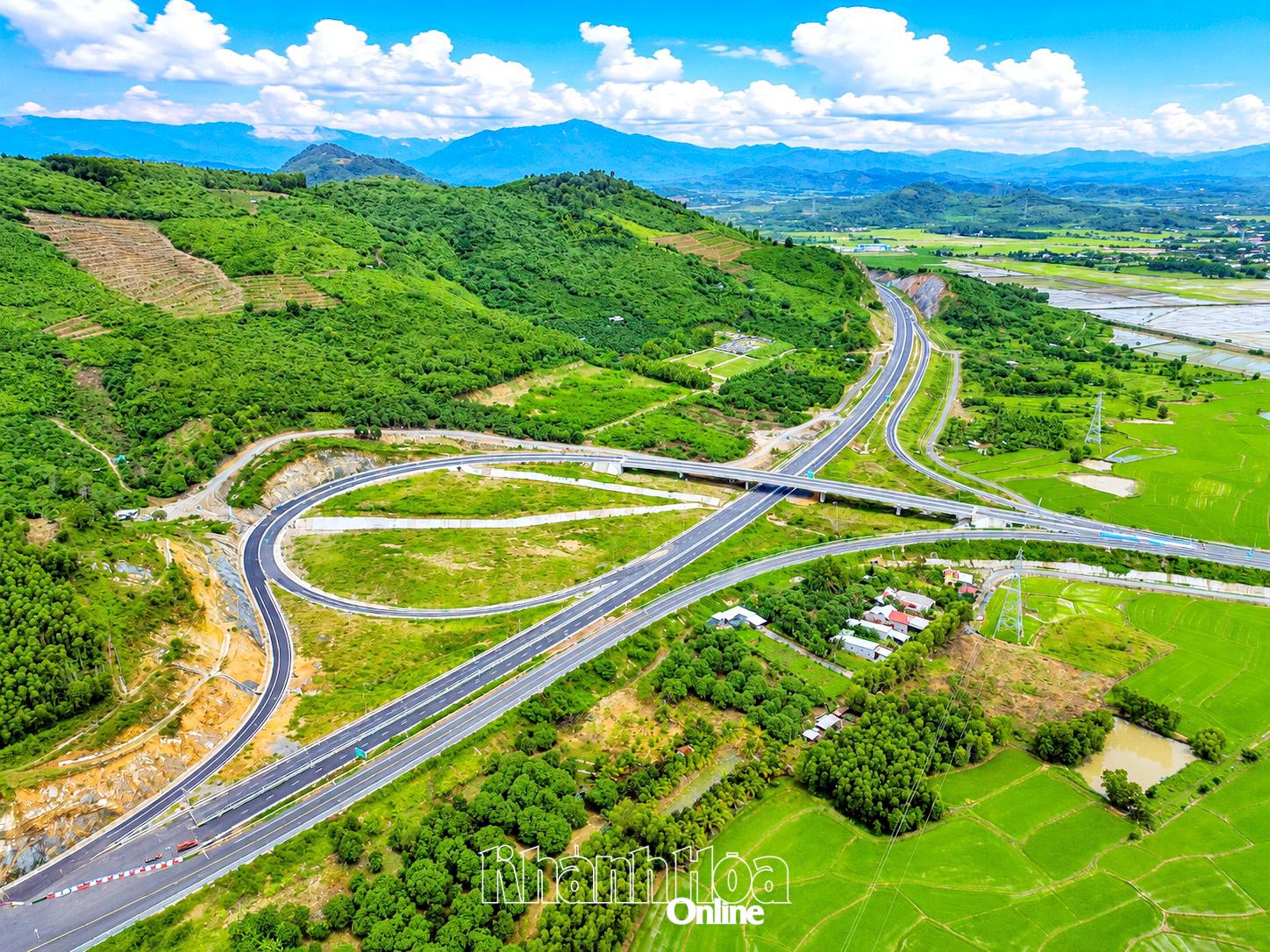 |
| An aerial view of Van Phong - Nha Trang Expressway. |
In the transport sector, priority is given to projects that enhance regional connectivity and expand development space through 2030, such as Khanh Hoa - Buon Ma Thuot Expressway, Nha Trang - Da Lat Expressway, the upgrade of National Highway 26B, high-speed rail lines, the expansion of Cam Ranh International Airport and Van Phong Airport, and Cu Hin Tunnel. Concurrently, the province is prioritizing investment in coastal and inter-regional roads and the development of the seaport system, with a specific vision to transform Van Phong into an international transshipment port.
The industrial landscape is defined by a new system of industrial zones, including Doc Da Trang, Ninh Xuan, Ninh Diem 1, Ninh Diem 2, Ninh Diem 3, Ca Na, and Nam Cam Ranh. Notably, these projects rely primarily on non-budgetary capital, reflecting a strategy to leverage planning and infrastructure to attract private resources for industrial development.
In the urban sector, large-scale projects continue to play a pivotal role in shaping new development areas, including: Cam Ranh Bay waterfront urban area (approx. 1,254 ha), Cam Lam New Urban Area (approx. 10,365 ha), Tu Bong high-end new urban area (over 2,579 ha), Dam Mon high-end multi-functional urban area (over 1,440 ha), and the Nha Trang City mixed-use urban area (approx. 227 ha). All these projects are designated for non-budgetary funding.
To implement this substantial volume of projects, the program targets a total social investment capital of VND 1.05 quadrillion for the 2026–2030 period, representing an average annual increase of over 20% and a 2.1-fold rise compared to the 2021–2025 period. The guiding principle is the focused allocation of resources, with public investment playing a leading role in catalyzing social capital.
In addition to projects that drive economic growth, the program prioritizes infrastructure serving public welfare and sustainable development, such as: the flood drainage system west of Nha Trang, reservoirs and irrigation works, the provincial General Hospital, the provincial General Museum, and the provincial sports complex... innovation park. At the same time, the province aims to develop new models such as green industrial centers (targeting net-zero emissions), free trade zones, and logistics hubs in Van Phong and Ca Na.
Along with identifying priority tasks and projects, the program clearly assigns responsibilities to specific departments, agencies, and localities for implementation. Specialized agencies are to operationalize details regarding investment, construction, land use, infrastructure, and socio-economic development based on their assigned functions; meanwhile, communes, wards, and special zones must review local programs, schemes, and plans to ensure alignment with the provincial Master Plan. By August 20, 2026, departments, agencies, and localities must issue their action programs and plans, clearly defining objectives, tasks, and timelines. Implementation results will be consolidated and evaluated on an annual basis.
Manh Hung
Translated by T.T





Thông tin bạn đọc
Đóng Lưu thông tin