
Recently, vocational training institutions in Khanh Hoa Province have innovated enrollment consulting for the 2025-2026 school year with applications having reached over 50% of the targeted enrollment. Institutions are implementing initiatives to attract more learners and are determined to meet their enrollment goals.
Broadening enrollment guidance approaches
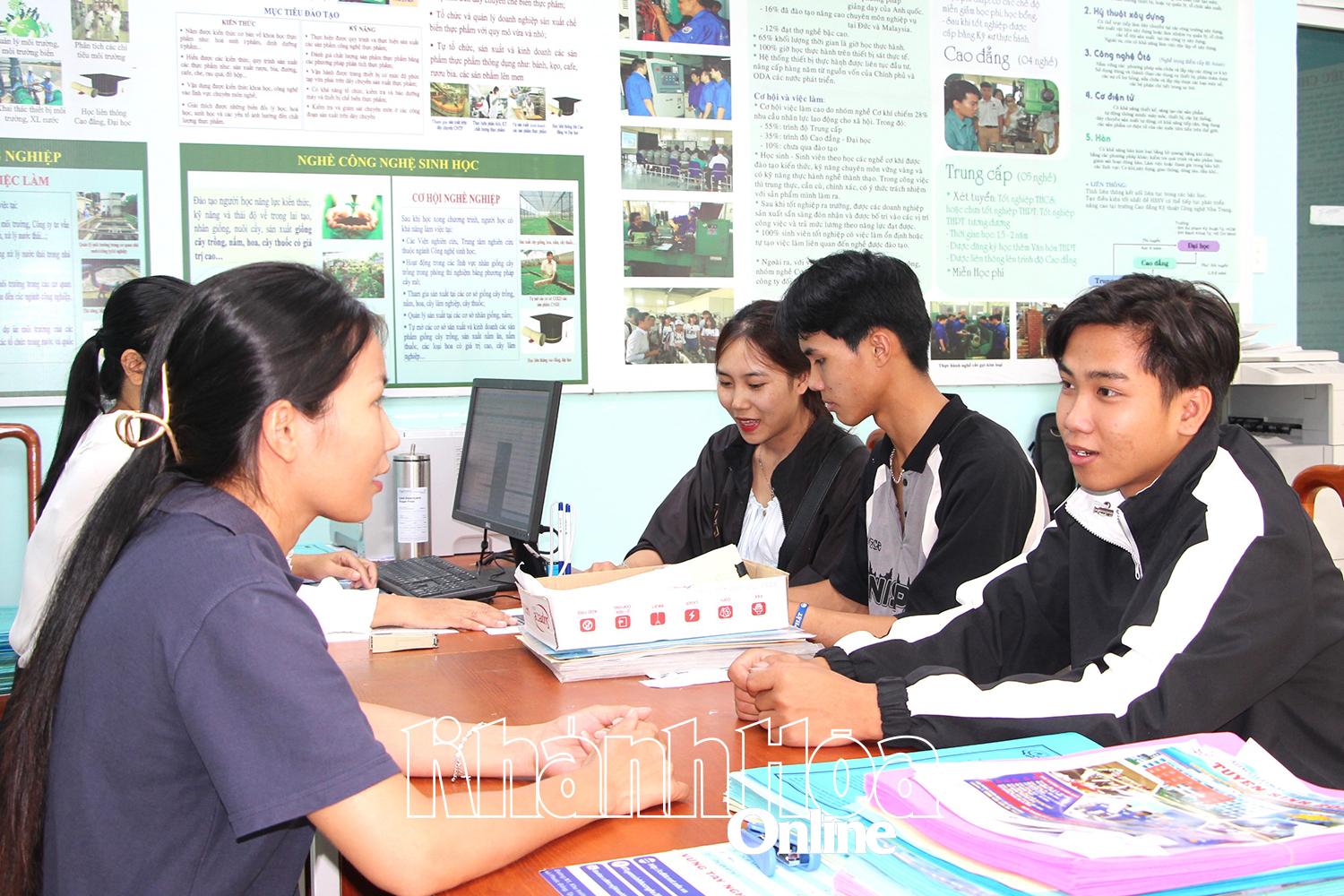
Tran Gia Bao (Hoa Thang Ward) has decided to apply to Nha Trang College of Technology (Nam Nha Trang Ward). He said: “When I was in grade 12 at Nguyen Chi Thanh High School, Nha Trang College of Technology organized a career guidance session to introduce its training programs, preferential policies and the benefits of vocational education. Therefore, after finishing high school, I applied to the college and chose to study refrigeration and air conditioning engineering.”
To attract students, in addition to direct consulting sessions at high schools, Nha Trang College of Technology has also used social networks, media, and websites to provide admission information. “Career Experience Day” was also held for high school students to experience the workshops and laboratories, helping them better understand the profession, thereby they can choose suitable specialties for their abilities and interests. The college has enrolled more than 50% of the targets of enrolling 800 and 700 at intermediate and college levels so far. The college is focusing on admission counseling for those who have taken their high school graduation exam.
 |
|
Nha Trang College of Technology staff provide enrollment guidance and receive students' admission applications. |
Khanh Hoa College of Technology and Energy (Dong Hai Ward) Admissions for the 2025-2026 academic year are underway. According to Principal Nguyen Phan Anh Quoc, this year, the college has an enrollment target of 850 students. In addition to direct counseling together with the application of digital technology in approaching learners, the college has also promoted admission counseling via Facebook, Zalo, YouTube, TikTok, giving students a general and specific view of the university's specialties.
The college has also organized a consultation day with businesses, alumni, providing prospective learners with valuable insights into academic programs while also offering early networking opportunities with potential employers. The college has so far enrolled 560 students. It is now prioritizing outreach by updating records of students who have taken the high school exam and conducting direct phone consultations. With this proactive approach, the college is aiming to recruit approximately 1,000 students for the 2025–2026 academic year.
Vocational high schools in the province are also making efforts to innovate and diversify forms of admission consultation, and reaching an enrollment of more than 50% of the target. According to statistics from the Department of Education and Training, by July 29, vocational colleges had received over 1,140 applications for college-level programs and more than 660 for intermediate-level programs. Additionally, vocational secondary schools admitted 1,370 students.
Innovating and enhancing training quality
In 2024, vocational training institutions in the province recruited and trained 42,343 people. Vocational training institutions also fully implemented vocational training support policies for 612 young people who completed their military service; 816 workers in small and medium enterprises; 45 workers with disabilities; supported vocational training for 835 workers under the National Target Program for Socio-economic Development in Ethnic Minority and Mountainous Areas; 228 workers under the National Target Program for Sustainable Poverty Reduction, contributing to increasing the rate of trained workers in the province to 79.1% with 31% holding formal degrees or certificates.
In the 2025-2026 school year, vocational training institutions continue innovating and improving training; strengthening partnerships with businesses in training, hands-on practice and job placement opportunities for graduates; investing in modern equipment and applying information technology and promoting digital transformation in management, teaching and learning.
Additionally, the schools have implemented Standards for Accreditation of Vocational Education Quality, fostering active teaching methods aligned with learning outcomes in vocational education, promoting the use of digital learning resources and the development of online instructional videos. Currently, 2 colleges and 6 vocational high schools have updated 24 training programs in accordance with regulations on minimum knowledge and competency requirements of learners.
V.G
Translated by N.T








Thông tin bạn đọc
Đóng Lưu thông tin