
Resolution No. 09 by the Politburo on the construction and development of Khanh Hoa Province to 2030 vision to 2045 defines some tasks and solutions to improve healthcare in the province. In particular, the resolution states the focus on promoting digital transformation to create a foundation for Khanh Hoa to become a regional and national center for high-quality healthcare. To effectively carry out the tasks, the provincial health sector has identified the development of a smart healthcare network as a key factor.
Tremendous efforts
A smart healthcare system requires 5 key components, including digital infrastructure, e-health records, artificial intelligence combined with predictive analytics, telemedicine combined with virtual healthcare and cybersecurity. In Khanh Hoa Province, the provincial public hospital system as well as private medical facilities, have been implementing solutions towards building smart hospitals, gradually forming a flexible and modern smart medical network.
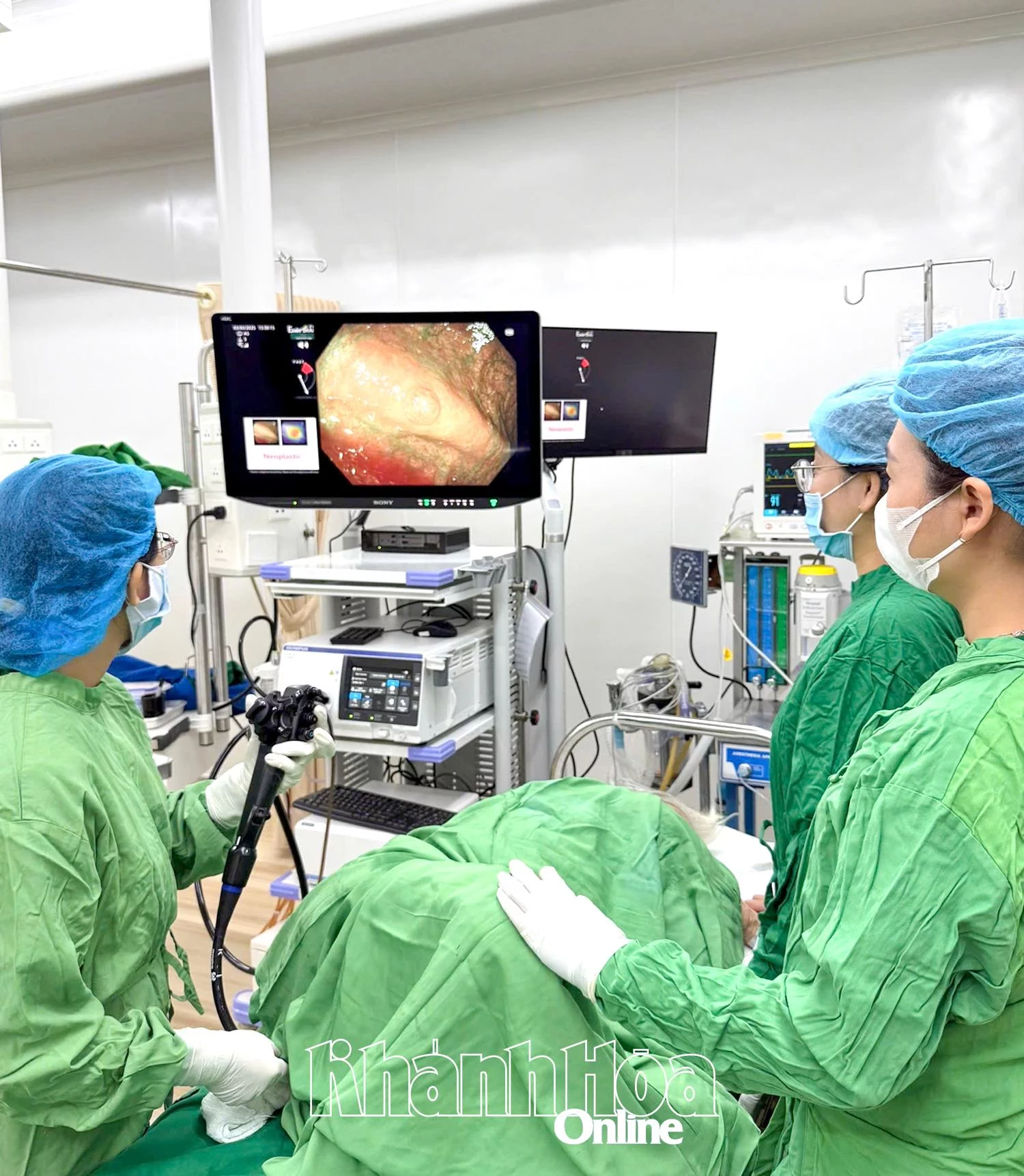 |
| AI-integrated endoscopy at Khanh Hoa Provincial General Hospital. |
Taking the role of the core hospital of the South Central Coast region in providing advanced and specialized medical services, in recent years, the hospital has integrated a comprehensive Hospital Information System (HIS) and developed smart healthcare services, including online medical appointment booking, mobile access to test results and cashless payment options; invested in equipment systems featuring artificial intelligence applications with an AI box for gastrointestinal diagnostics; medical image storage and transmission system and information system for diagnostic imaging.
In addition, the hospital has hosted several forums to foster collaboration among technology experts, administrators, enterprises, and both domestic and international medical organizations. These events have focused on exploring innovative solutions and emerging trends in the development of smart hospital models for the coming years. As a result, the hospital’s medical services have seen significant improvement, attracting numerous domestic specialists to provide care not only for local residents but also for patients from neighboring provinces.
Most general and specialized hospitals in the province have been equipped with smart medical kiosks designed for efficient check-ins and data management. The Mental Hospital and Dien Khanh General Hospital have deployed e-medical records.
Obstacles still remain
Smart healthcare is not just a matter of technology, but also a holistic transformation model, in which people are at the center. Building a smart healthcare system requires a combination of many factors, from funding to infrastructure, human resources, policies, etc.
Currently, the construction and development of the provincial health sector still has some shortcomings and limitations in terms of infrastructure, technology, human resources, funding, etc.
PhD. Dr. Dang Duy Thanh, Deputy Director of the Provincial General Hospital, affirmed, "Implementing a smart hospital model is not an easy task. Transitioning toward smart healthcare requires substantial financial investment for establishing, maintaining and upgrading advanced information technology systems.”
Recently, the Provincial People's Council organized a workshop on "Special mechanisms and policies to attract human resources to meet the requirements of developing high-quality healthcare and towards a smart healthcare system, lessons learned from the world and Vietnam". At the workshop, many experts, scientists, and health sector officials made recommendations and proposals related to building a smart healthcare system for Khanh Hoa province in the next 5 years. In particular, priority is given to digital transformation, human resource training, policies and mechanisms to deploy many models of medical examination and treatment geared toward convenience and digitalization, attracting high-quality professionals to the healthcare sector.
Speaking at the workshop, Pham Thi Xuan Trang, Vice-Chairperson of the Provincial People's Council, said, "Smart healthcare is identified as one of the 6 key tasks in the digital transformation program, with the goal of applying digital platforms to improve the quality of medical service, reduce costs and optimize operational efficiency. Therefore, the provincial health sector needs to focus on implementing 3 core tasks: The provincial health sector should prioritize three core initiatives: the synchronized implementation of electronic medical records, digital prescriptions, and personal health records seamlessly integrated with the national platform; the application of artificial intelligence across clinical diagnostics and hospital management; and the expansion of remote medical services and the development of smart healthcare applications to improve accessibility and efficiency.
The great concern of the central and local governments when integrating smart healthcare into the provincial socio-economic development strategy; combined with Khanh Hoa Province’s emerging role as the hub of the South Central Coast, rising healthcare demands, and the nationwide push for digital transformation in the health sector has created favorable conditions for attracting investment, accelerating progress, and pioneering innovative smart healthcare models in the near future.
C.D
Translated by N.T










Thông tin bạn đọc
Đóng Lưu thông tin